In the early 1900s, scientists were quietly chasing two completely separate mysteries. In one line of research, certain diets made laboratory animals stop growing and eventually die, no matter how much protein, carbohydrate, or fat they contained. In another, doctors had long noticed that poorly fed populations sometimes went blind in dim light. Nobody yet suspected these were the same problem. It would take nearly two decades, a Wisconsin rat lab, a Swiss chemist, and a young researcher who collected thousands of animal eyes from slaughterhouses to prove they were.
Two Mysteries, One Missing Nutrient
By 1906, English biochemist Frederick Gowland Hopkins was already convinced that something was missing from the standard picture of nutrition. He proposed that beyond carbohydrates, proteins, fats, minerals, and water, diets required "accessory food factors" present in tiny amounts, but essential for life. It was a radical idea at the time; the scientific consensus held that those five categories covered everything a body needed. Hopkins would later win the 1929 Nobel Prize for being right.
Separately, doctors treating malnourished populations kept observing something else: people whose diets lacked fat sources like butter and eggs sometimes developed night blindness and a dangerous corneal condition. Nobody had connected the dots yet but both threads were about to converge on the same answer.
The Wisconsin Rat Experiments
In 1913, biochemist Elmer McCollum and his research partner Marguerite Davis, working at the University of Wisconsin, ran a deceptively simple experiment. They fed rats diets that were identical in every way except for the source of fat some got butterfat or egg yolk, others got lard or olive oil. The rats on butterfat and egg yolk thrived. The rats on lard and olive oil stopped growing and eventually died, regardless of how much of everything else they were fed.
McCollum and Davis had found a substance essential for life, hiding inside certain fats and completely absent from others. They called it "fat-soluble factor A" deliberately avoiding any claim about its chemical identity, since they didn't yet know what it actually was. Almost simultaneously, and entirely independently, researchers Thomas Osborne and Lafayette Mendel at Yale arrived at strikingly similar conclusions one of several moments in this story where more than one lab reached the same discovery at nearly the same time.
A Detective Story in Leaves
The Wisconsin team's finding immediately raised an awkward question: wild animals don't drink milk after they're weaned, and most don't eat eggs either, yet they clearly thrive without either food. If "fat-soluble A" was essential for life, it had to exist somewhere else too.
McCollum and Davis went looking, testing food after food, and it wasn't in grains, and it wasn't in meat. Eventually, they tried extracts of alfalfa leaves and found the substance in significant quantities. It turned out to be present in leafy greens generally, the first plant-based source identified. The discovery even explained an earlier puzzle in McCollum's own research: cows fed processed wheat (which strips out the leafy, chaffy parts of the plant) fared far worse than cows fed processed corn (which, because of how it was harvested at the time, kept the leaves). The missing variable had been sitting in plain sight the entire time.
The Other Half of the Story: Night Blindness
While the Wisconsin lab was chasing a growth factor, a Japanese researcher named Ishihara was independently investigating something that looked, on the surface, like a completely different problem publishing, in that same pivotal year of 1913, a theory that a "fatty substance" in the blood was necessary for both the health of the cornea and the synthesis of rhodopsin, the light-sensitive pigment in the retina. His theory proposed that a deficiency of this substance caused both night blindness and a dangerous clouding of the cornea.
It took another dozen years for anyone to directly connect this to McCollum's fat-soluble factor. In 1925, researchers Fridericia and Holm demonstrated in animal experiments that vitamin A deficiency directly caused night blindness. By 1929, Holm had shown vitamin A was present in retinal tissue itself. The growth-factor story and the night-blindness story were, it turned out, the same story all along.
Naming and Mapping the Molecule
The substance's name kept evolving as understanding of it deepened: "fat-soluble factor A" in 1913, formally described as fat-soluble in 1918, and referred to simply as "vitamin A" by 1920. In 1922, McCollum and colleagues realized that what they'd been calling one fat-soluble substance was actually two distinct vitamins the second one would later be identified as vitamin D.
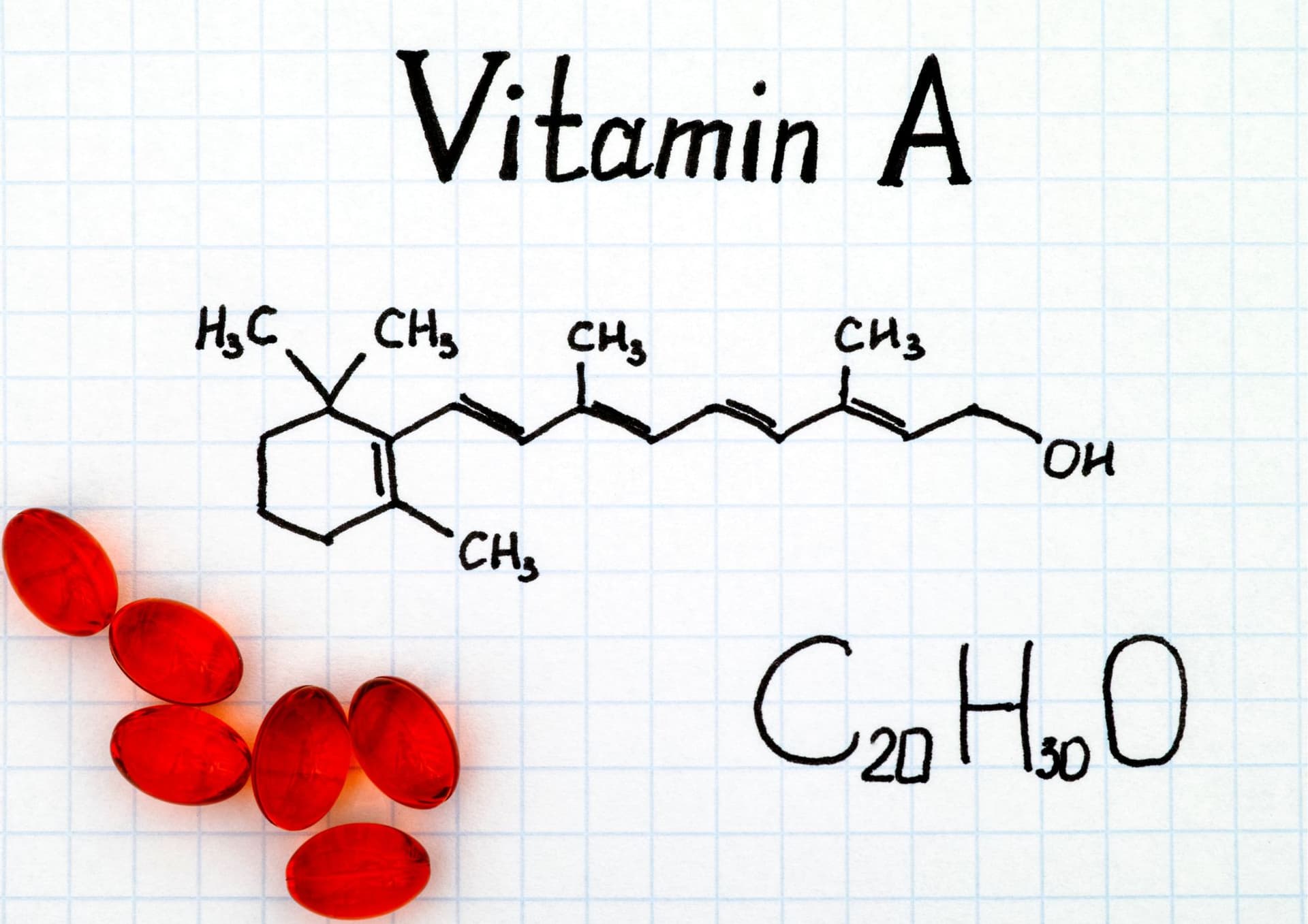
The real breakthrough in understanding what vitamin A actually was, chemically, came from Swiss chemist Paul Karrer. In 1930, Karrer worked out the correct structural formula for beta-carotene, the orange-yellow plant pigment found in carrots and other vegetables. The following year, he went further, extracting vitamin A itself from cod liver oil and determining that the vitamin A molecule was essentially half of a carotene molecule the first time the complete chemical structure of any vitamin had ever been mapped.
A Young Researcher and a Warehouse of Eyes
In 1932, a young American researcher named George Wald the son of poor Jewish immigrants who had grown up in Brooklyn received a research fellowship and made his way to Otto Warburg's laboratory in Berlin. There, he dissected animal retinas, isolated the light-sensitive purple pigment rhodopsin, and ran a chemical test suggesting the retinas contained vitamin A.
Warburg suggested Wald travel to Zurich to confirm the result with the one person who could settle it for certain: Paul Karrer himself, who had just finished mapping vitamin A's structure. Wald and his wife spent months collecting thousands of eyes from sheep, pigs, and cattle at slaughterhouses, extracting the retinas, and testing them. Working alongside Karrer, they confirmed it: the retinas were rich in vitamin A. The growth-factor story and the vision story had officially become one.
The Full Picture of Vision
Wald didn't stop there. Over the following years, he and his colleagues worked out the complete photochemistry of vision: light striking the eye breaks rhodopsin down into two components retinal, which is simply the aldehyde form of vitamin A, and a protein called opsin. This breakdown-and-regeneration cycle is the literal molecular basis of how eyes detect light. In 1942, researchers Selig Hecht Wald's own former mentor and colleagues showed that this system was sensitive enough for a single rod cell to be triggered by a single photon of light.
In 1937, Paul Karrer received the Nobel Prize in Chemistry for his structural work on vitamin A and related compounds. Three decades later, in 1967, George Wald received his own Nobel Prize in Physiology or Medicine, shared with Ragnar Granit and Haldan Keffer Hartline, for explaining the visual process that vitamin A makes possible.
Why This Story Still Matters
Vitamin A holds a genuinely unusual distinction in nutrition history: it was the first vitamin ever identified as a distinct "fat-soluble factor," in 1913, and the first vitamin to have its complete chemical structure mapped, in 1931. But what makes the story worth telling isn't the list of firsts it's the fact that two seemingly unrelated medical mysteries, chased by researchers on different continents who had no idea they were working on the same problem, turned out to have a single answer. Every time you read in dim light without a second thought, you're relying on a molecular process that took the better part of three decades, and several Nobel Prizes, to fully understand.
Frequently Asked Questions
Who discovered vitamin A? No single person it emerged from several converging lines of research. Elmer McCollum and Marguerite Davis identified it as a distinct "fat-soluble factor" in 1913, Paul Karrer mapped its chemical structure in 1931, and George Wald established its role in vision in the 1930s.
When was vitamin A discovered? It was first identified as a distinct dietary factor in 1913, though it wasn't formally called "vitamin A" until around 1920, and its full chemical structure wasn't determined until 1931.
Why is vitamin A connected to both growth and vision? These were originally investigated as two unrelated problems by different researchers. It took until the mid-1920s for scientists to prove that the same fat-soluble nutrient responsible for normal growth was also responsible for night vision.
Did anyone win a Nobel Prize related to vitamin A? Yes three, across three different decades. Frederick Gowland Hopkins won in 1929 for his foundational "accessory food factors" theory, Paul Karrer won in 1937 for mapping vitamin A's chemical structure, and George Wald won in 1967 for explaining its precise role in vision.
Sources consulted: ScienceDirect (Handbook of Clinical Neurology, historical review of vitamin A); Science History Institute; Johns Hopkins University historical analysis; On Wisconsin Magazine; Nobel Prize biographical and historical archives; Mayo Clinic Proceedings biographical profile of Paul Karrer; National Academy of Sciences biographical memoir of George Wald.